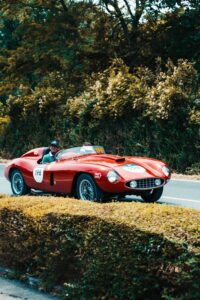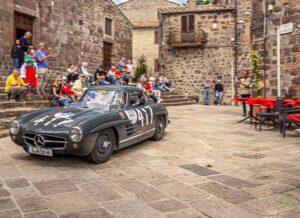
Discover how the Mille Miglia began, why it became motorsport’s greatest road race, and how you can experience its legendary route today with Nostalgic.
The Birth of the Mille Miglia
On March 26, 1927, four men from Brescia changed motorsport forever.
Count Aymo Maggi, Count Franco Mazzotti, Renzo Castagneto, and journalist Giovanni Canestrini created a road race unlike anything the world had ever seen.
Their idea was simple—but revolutionary.
A race of approximately 1,000 miles (1,600 km) on ordinary public roads, from Brescia to Rome and back again.
They called it the Coppa delle Mille Miglia.
Years later, Enzo Ferrari famously described it as:
“The most beautiful race in the world.”
Nearly a century later, those words still define the event.
Why Was the Mille Miglia Created?
The story begins with disappointment.
In 1926, Brescia lost the Italian Grand Prix to Monza. Overnight, the city that had once been Italy’s racing capital lost its biggest event.
Rather than accept defeat, four passionate racing enthusiasts decided to create something entirely new.
On December 2, 1926, they met in Milan to design a race unlike any before it.
When someone calculated the distance at roughly 1,000 miles, Franco Mazzotti reportedly replied:
“Then why don’t we simply call it the Mille Miglia?”
The name appeared in La Gazzetta dello Sport only weeks later.
Today, you can drive alongside the official event during one of Nostalgic’s curated classic car tours—without owning an eligible Mille Miglia car or navigating the complicated application process.
The First Mille Miglia in 1927
On the morning of March 26, 1927, the first competitor rolled down the start ramp on Viale Venezia in Brescia.
A total of:
- 77 cars started
- 54 reached the finish
- Winners: Ferdinando Minoia and Giuseppe Morandi
- Car: OM 665 Sport
- Time: 21 hours, 4 minutes
- Average speed: 48 mph (77 km/h)
There were no guardrails.
No purpose-built race circuit.
No safety barriers.
Only public roads stretching across Italy.
The original route formed a giant figure-eight between Brescia and Rome—a layout that the modern Mille Miglia periodically recreates.
Tazio Nuvolari’s Legendary Night Drive
Few moments in motorsport history are as famous as Tazio Nuvolari’s victory in 1930.
Chasing rival Achille Varzi, Nuvolari switched off his headlights during the night to avoid being seen.
He followed silently through the darkness.
Only moments before overtaking did he turn his lights back on.
By then, it was too late for Varzi.
The daring maneuver became one of the defining legends of the Mille Miglia.
Stirling Moss’s Record-Breaking 1955 Victory
If one performance defines the Mille Miglia, it is Stirling Moss’s drive in 1955.
Together with navigator Denis Jenkinson, Moss completed the entire route in:
- 10 hours, 7 minutes
- Average speed: 98 mph (157.65 km/h)
Jenkinson navigated using handwritten pace notes rolled onto a paper scroll mounted inside the car—a technique that would later inspire modern rally racing.
The record still stands.
It can never be broken because the Mille Miglia is no longer run as a speed race.
Why the Original Mille Miglia Ended
The final competitive Mille Miglia took place in 1957.
Near Guidizzolo, just 25 miles from the finish, Alfonso de Portago’s Ferrari 335 S suffered a catastrophic tire failure at more than 155 mph (250 km/h).
The crash claimed the lives of:
- Alfonso de Portago
- Co-driver Edmund Nelson
- Nine spectators, including five children
Twenty more people were injured.
Only days later, Italy banned road racing on public highways.
The original Mille Miglia had come to an end.
Enzo Ferrari was charged with manslaughter following the accident but was acquitted in 1961.
The tragedy permanently changed international motorsport safety.
The Mille Miglia Returns
After a twenty-year absence, the event returned in 1977.
But this time it was different.
Instead of racing for outright speed, competitors would drive a regularity rally, where precision and consistency replaced flat-out competition.
Today, only cars built between 1927 and 1957 that are eligible under the Mille Miglia registry may officially enter.
That exclusivity has made today’s Mille Miglia one of the world’s most prestigious historic motoring events.
What Makes the Mille Miglia Different?
Unlike Le Mans, Monaco, or Formula One, the Mille Miglia was never confined to a race circuit.
Instead, it flowed through everyday Italy.
Drivers raced:
- Through medieval villages
- Across mountain passes
- Along vineyard roads
- Past lakes, churches, farms, and city squares
Spectators often stood only a few feet from the passing cars.
There were no grandstands.
No stadium atmosphere.
The race became part of Italian life itself.
That connection between people, roads, and automobiles remains the soul of the Mille Miglia today.
Experience the Mille Miglia with Nostalgic
Owning an eligible Mille Miglia car is beyond the reach of almost everyone.
Fortunately, experiencing the event isn’t.
Nostalgic’s guided classic car tours allow you to drive historic Alfa Romeo Spiders and Mercedes-Benz SLs through the very regions where the Mille Miglia unfolds.
You’ll enjoy scenic driving roads, charming Italian villages, and unforgettable access to one of the world’s greatest automotive events—without the years of preparation required for official entry.
Explore Nostalgic’s Mille Miglia Tours and discover Italy the way it was meant to be driven.
Frequently Asked Questions
Who founded the Mille Miglia?
The Mille Miglia was founded by Aymo Maggi, Franco Mazzotti, Renzo Castagneto, and Giovanni Canestrini. The first race took place on March 26, 1927, beginning and ending in Brescia.
Why did the Mille Miglia stop?
The original speed race ended after the tragic 1957 Guidizzolo accident, when Alfonso de Portago’s Ferrari crashed into spectators. Shortly afterward, Italy banned road racing on public highways.
Does the Mille Miglia still exist?
Yes. Since 1977, the Mille Miglia has been held as a historic regularity rally rather than a speed race. Eligible classic cars follow much of the original route from Brescia to Rome and back.
Why is the Mille Miglia called “The Most Beautiful Race in the World”?
Enzo Ferrari famously described the Mille Miglia as “the most beautiful race in the world” because it combined extraordinary automobiles with Italy’s spectacular scenery, historic towns, and passionate crowds—creating an event unlike any other in motorsport.
Can anyone participate in the Mille Miglia?
Official entries are limited to historically eligible vehicles built between 1927 and 1957 that appear on the Mille Miglia Registry. However, Nostalgic offers curated classic car tours that allow guests to experience the atmosphere of the Mille Miglia from behind the wheel of a vintage Alfa Romeo or Mercedes-Benz, without owning an eligible race car.