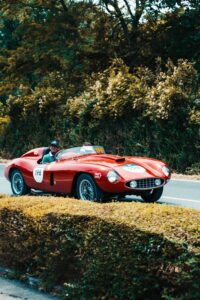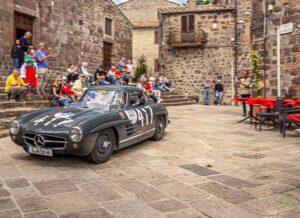
A Ferrari from the 1950s exits a corner on Siena’s Piazza del Campo. The light is perfect. The background is timeless. And you are standing in exactly the right place.
Where you stand changes everything.
The Mille Miglia offers three completely different types of viewing locations, and each creates a different experience. The best place for atmosphere is not necessarily the best place for photography. The best photo is not always taken where the largest crowds gather.
This guide explains the best Mille Miglia 2026 viewing spots, how to position yourself, and what type of experience each location offers.
The Three Types of Mille Miglia Viewing Spots
Many first-time visitors simply choose the nearest roadside location and wait.
That works.
But with a little planning, the Mille Miglia becomes something completely different.
The three main viewing experiences are:
- Historic city squares
- Mountain roads and countryside passes
- Lunch stops and official checkpoints
Each offers a different way to experience Italy’s most famous classic car event.
Historic City Squares: Atmosphere, Architecture, and Iconic Images
Some locations offer something a mountain road never can.
Historic architecture.
Crowds filling ancient streets.
The sound of hundreds of classic engines echoing between centuries-old buildings.
Famous locations include:
- Viale Venezia in Brescia — the legendary start and finish location
- Piazza del Campo in Siena — one of the most spectacular backdrops of the entire route
- Ferrara’s historic center — where the route traditionally passes through
In these locations, the cars move more slowly, allowing spectators to get closer.
For photographers, these locations are special because the background does much of the work.
A 70-year-old Alfa Romeo passing beneath medieval stone buildings needs no artificial setting.
The challenge is the crowds.
Arrive early. Avoid standing in the middle of a straight road. The best position is often near a corner exit, where the car turns toward you and the historic surroundings remain visible behind it.
Mountain Roads and Scenic Passes: The Closest Driving Experience
For many enthusiasts, this is the real Mille Miglia.
Locations such as:
- The Crete Senesi in Tuscany
- The roads around Lake Garda
- The Furlo Gorge
- The Apennine mountain passes
offer something completely different.
Fewer people.
More space.
And classic cars moving through the Italian landscape exactly as they were meant to be experienced.
A Ferrari, Alfa Romeo, or Maserati from the 1950s appearing around a mountain corner with nothing between you and the road is one of the defining Mille Miglia moments.
For photographers, these are often the most rewarding locations.
The car becomes part of the landscape:
- Tuscan hills
- Mountain rock formations
- Italian villages
- Lake views
The vehicle may only fill part of the image.
The rest tells the story.
Lunch Stops: The Best Opportunity for Close-Up Photos
Many spectators overlook the lunch stops.
That is a mistake.
Locations such as:
- Modena
- Gubbio
- Mantua
offer one of the most personal Mille Miglia experiences.
The cars stop.
Drivers and co-drivers step out.
Engines cool down.
Spectators can see details impossible to capture while the cars are moving:
- Open engine compartments
- Historic dashboards
- Steering wheels from the 1950s
- Original race numbers
- Drivers discussing the route
For photography, this is often the easiest and most rewarding environment.
No long lenses are required.
No timing a fast-moving vehicle.
Just patience and observation.
How to Take Better Mille Miglia Photos
Knowing where to stand is only half the challenge.
Timing and preparation matter just as much.
Photography Tips for City Locations
Arrive 45–60 minutes before the expected arrival time.
Do not stand directly in the center of the road.
Instead, look for:
- A corner exit
- Interesting architecture behind the cars
- A position where crowds remain to the side
A lower camera angle often creates stronger images.
The car appears larger, the background becomes more dramatic, and the classic proportions of the vehicle become more visible.
Remember that the moments before and after the cars pass are often the best:
- Drivers waving
- Crowds reacting
- The atmosphere after the last car disappears
Photography Tips for Country Roads
Choose the background first.
Ask yourself:
What will be behind the car when it passes?
The best images combine the vehicle with Italy itself:
- Tuscan landscapes
- Mountain roads
- Lakes
- Vineyards
Use continuous shooting mode.
The cars arrive quickly, and they do not come back.
Photography Tips at Lunch Stops
Do not rush immediately toward the cars.
Watch first.
The strongest images often happen after the initial excitement disappears.
Look for moments:
- A driver explaining something beside the car
- A mechanic checking an engine
- A passenger relaxing after the morning drive
- Small details that tell the story
Mille Miglia Photography Etiquette: What Works and What Doesn’t
The Mille Miglia takes place on public roads, but experienced spectators understand there are unwritten rules.
Good practice:
✓ Arrive early
✓ Respect other spectators
✓ Ask before touching vehicles
✓ Speak with drivers politely
✓ Keep pathways clear
Avoid:
✗ Flash photography toward moving vehicles
✗ Large tripods in crowded areas
✗ Blocking other people’s views
✗ Entering restricted areas
Most importantly:
Never step onto the active route while cars are moving.
When Do Mille Miglia Cars Arrive?
Exact times vary each year.
Local towns usually publish approximate arrival schedules, and official updates are released through Mille Miglia communication channels.
Remember:
The schedule is approximate.
Delays of 30–60 minutes are normal.
The best strategy is simple:
Choose your location.
Arrive early.
Enjoy the atmosphere.
The Best Camera Equipment for the Mille Miglia
The best Mille Miglia photos do not come from the most expensive equipment.
They come from the best position.
A useful setup:
- Zoom or telephoto lens for mountain roads
- Wide-angle lens for city squares
- Extra batteries
- Fast memory card
Leave behind:
- Large tripods
- Drones
- Flash equipment
The Mille Miglia moves quickly.
Your equipment should not slow you down.
Experience the Mille Miglia with Nostalgic
Finding the perfect viewing locations takes planning.
With a Nostalgic classic car tour, the best moments of the Mille Miglia are already built into your journey.
Drive through Italy in a historic Alfa Romeo Spider or Mercedes-Benz SL, experience the legendary roads, and watch the world’s most famous classic cars pass through the landscapes that made the event legendary.
Explore Nostalgic Mille Miglia 2026 Tours and experience the race from behind the wheel.
Frequently Asked Questions
Where is the best place to watch the Mille Miglia?
The best location depends on the experience you want.
For atmosphere and iconic photography:
- Siena’s Piazza del Campo
- Brescia’s Viale Venezia
For dramatic driving scenes:
- Tuscany’s countryside roads
- Mountain passes
- Furlo Gorge
For close access to the cars:
- Lunch stops such as Modena, Gubbio, and Mantua
Do I need a professional camera for the Mille Miglia?
No.
A modern smartphone works very well at city locations and lunch stops where cars move slowly or are stationary.
For mountain roads, a camera with a zoom lens provides a significant advantage because the vehicles pass quickly.
How early should I arrive at Mille Miglia viewing spots?
For famous city locations such as Siena and Brescia, arrive 45–60 minutes before the expected arrival time.
For countryside roads and mountain passes, 20–30 minutes early is usually sufficient.
Lunch stops are more relaxed because the vehicles remain for longer periods.
Can I see the Mille Miglia without buying a ticket?
Yes.
The Mille Miglia route runs on public roads, and spectators can watch from many locations without paying admission.
However, the best experiences require planning—knowing the route, timing, and locations where the cars stop.