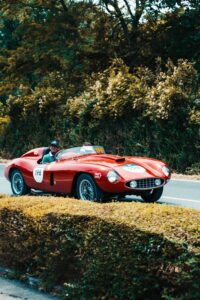
The Mille Miglia 2026 follows its historic five-day route across Italy, beginning and ending in Brescia. More than 400 original classic cars built between 1927 and 1957 will travel nearly 1,000 miles through Italy’s lakes, mountains, medieval cities, and countryside before returning to where it all began.
Knowing where the Mille Miglia travels each day transforms the experience. This guide explains the complete 2026 route, highlights the best spectator locations, and helps you decide where to experience one of the world’s greatest motoring events.
The 2026 Mille Miglia Returns to the Historic Figure-Eight Route
The Mille Miglia follows a slightly different course every year.
For 2026, organizers return to the event’s traditional figure-eight route, with both the outbound and return journeys crossing through Ferrara before continuing south toward Rome and back to Brescia.
If you’ve attended previous editions—or are planning from older guides—the route will not be identical. Following the updated itinerary ensures you’re in the right place at the right time.
One advantage of the 2026 layout is that Ferrara becomes one of the few cities where spectators can see the rally twice without changing locations.
Day-by-Day Mille Miglia 2026 Route
Day 1 — Brescia to Padua
The adventure begins on Viale Venezia in Brescia, where every car leaves the starting ramp individually rather than in one large group.
From Brescia, the route winds through Valle Sabbia, Valle Trompia, and along the shores of Lake Garda before continuing through Vicenza and finishing in Padua.
For many spectators, the roads around Lake Garda offer one of the most beautiful settings of the entire rally—classic cars, mountain scenery, and sparkling water all in one place.
Day 2 — Padua to Montecatini Terme
The second stage crosses northern Italy through Ferrara, Modena, Reggio Emilia, and Lucca before reaching Montecatini Terme.
One of the day’s highlights is the lunch stop in Modena.
Unlike roadside viewing, this gives visitors the chance to walk among the cars while drivers take a break. It’s one of the best opportunities of the entire rally to photograph the vehicles up close and appreciate the incredible craftsmanship behind each historic automobile.
Day 3 — Montecatini Terme to Rome
For many enthusiasts, this is the defining day of the Mille Miglia.
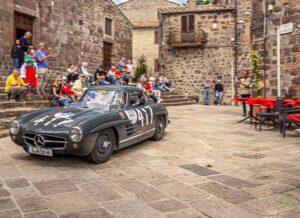
The route passes through Siena, where the magnificent Piazza del Campo becomes an unforgettable backdrop for more than 400 historic automobiles.
Ancient stone buildings, echoing engines, and some of the world’s most valuable classic cars create one of the rally’s most iconic scenes.
If you only have time to experience one stage of the Mille Miglia, this is the one to choose.
Planning to visit Tuscany during the event? Our Mille Miglia travel guide shows how to make the most of Siena and the surrounding countryside.
Later that evening, competitors arrive in Rome, where the atmosphere is electric, although the larger crowds make it harder to get close to the cars than in Tuscany.
Day 4 — Rome to Rimini
The return journey heads north through Assisi, Gubbio, and the dramatic Furlo Gorge before reaching Rimini.
This stage offers fewer crowds but some of the rally’s most spectacular driving roads.
The narrow mountain gorge, sweeping bends, and dramatic scenery create one of the most photogenic sections of the entire Mille Miglia—and surprisingly few spectators know about it.
Day 5 — Rimini to Brescia
The final day passes through Ferrara once again before continuing via Mantua back to Brescia.
The finish on Viale Venezia is one of the most emotional moments of the entire event.
After five unforgettable days and 1,000 miles across Italy, each car climbs the finishing ramp to applause from thousands of spectators who have followed the journey from start to finish.
The Best Places to Watch the Mille Miglia
Every spectator enjoys the rally differently.
Major cities like Brescia, Rome, and Rimini deliver the biggest atmosphere, packed streets, and exciting ceremonies, although crowds can make viewing more difficult.
Mountain roads around Lake Garda, the Apennines, and Furlo Gorge provide dramatic scenery and a much more intimate experience, with cars passing only a few feet away.
Midday control stops in places like Modena, Gubbio, and Mantua are often the hidden gems of the entire event. Here the cars stop, drivers mingle with spectators, and visitors enjoy rare close-up access that isn’t possible during the high-speed road sections.
Our guide to the best Mille Miglia viewing locations explains exactly where to stand for the best experience.
The Mille Miglia route is much more than a list of cities. It’s a journey through the very heart of Italy, with every stage revealing a different landscape, culture, and driving experience.
With a Nostalgic classic car tour, you experience these roads alongside the official Mille Miglia participants—without the complexity, expense, or years-long application process required for official entry.
Explore our Mille Miglia classic car tours and experience Italy’s greatest motoring event from behind the wheel of a classic Mercedes-Benz or Alfa Romeo.
Or, if you’re still planning your trip:
Read next: The History of the Mille Miglia: Why It’s Called The Most Beautiful Race in the World.
FAQ
Has the official Mille Miglia 2026 route been confirmed?
The overall figure-eight route beginning and ending in Brescia has been confirmed. Exact road sections and timing are typically finalized several months before the event. If you’re planning early, booking accommodations based on the confirmed overnight cities is the safest approach.
Can I use last year’s route to plan my trip?
Not entirely. While many famous locations return each year, the Mille Miglia changes its route annually. The 2026 edition returns to the historic figure-eight layout, making it different from recent years.
How long do the cars stop during each stage?
Lunch stops in cities such as Modena, Gubbio, and Mantua generally last one to two hours, giving visitors excellent opportunities to see the cars up close.
At overnight stops—including Brescia, Rome, and Rimini—the vehicles remain on display much longer, creating even more opportunities for photography and exploration.